Virtualization technology has revolutionized modern IT environments, enabling organizations to optimize resource utilization, reduce hardware dependency, and streamline management of their IT infrastructure. As organizations continue to evolve, selecting the right virtualization solution becomes critical to achieving scalability, reliability, and simplicity.
Two notable players in the virtualization space are Scale Computing and Proxmox Virtual Environment (Proxmox VE). While both offer robust solutions, they cater to different needs and organizational goals. Proxmox VE is known for its open-source approach and flexibility, while Scale Computing excels in providing a comprehensive, integrated platform designed for simplicity, high availability, and automation.
We’ll explore why Scale Computing, with its SC//HyperCore product, is the optimal Proxmox VE alternative for organizations seeking a virtualization solution that is easy to deploy, manage, and scale while delivering exceptional reliability and support.
Challenges with Proxmox VE
While Proxmox VE is a popular choice for organizations seeking an open-source virtualization platform, it comes with several challenges that can impact scalability, usability, and long-term operational efficiency. For organizations managing complex IT infrastructures, these limitations can introduce hurdles that make Proxmox VE alternatives like Scale Computing Platform a more attractive option.
Proxmox VE Limited Scalability for Large Enterprises
While Proxmox VE functions well for smaller deployments, expanding beyond a single data center or scaling across hundreds or thousands of locations becomes increasingly difficult. Proxmox VE requires users to manually manage multiple components, including Ceph, for software-defined storage, leading to increased complexity and operational overhead. In contrast, Scale Computing offers a fully integrated hyperconverged infrastructure (HCI) that streamlines resource management and scales efficiently across distributed environments without requiring specialized IT expertise.
Steeper Learning Curve for New Proxmox VE Users
Unlike enterprise-focused solutions that emphasize intuitive management, Proxmox VE requires a deeper understanding of Linux, networking, and virtualization concepts to configure and maintain effectively. Organizations with limited IT resources may struggle with the extensive setup, patching, and troubleshooting required for smooth operation. Scale Computing eliminates these challenges by providing an easy-to-use platform with automated intelligence, reducing administrative complexity and enabling IT teams to focus on higher-value tasks.
Performance Bottlenecks in Proxmox VE Edge Computing Scenarios
Proxmox VE can introduce performance bottlenecks due to its reliance on Ceph for storage clustering. While Ceph is a powerful storage solution, it demands high levels of manual configuration and significant hardware resources, including a 10GbE networking requirement for optimal performance. The additional management burden can slow down deployments and increase infrastructure costs. Scale Computing, on the other hand, integrates storage directly into the hypervisor with its proprietary Scale Computing Reliable Independent Block Engine (SCRIBE) technology, delivering high performance without the need for complex third-party storage solutions.
Proxmox VE Lack of Comprehensive Customer Support
As an open-source platform, Proxmox VE primarily relies on community forums and online documentation for troubleshooting. While professional support subscriptions are available, they are limited to Austrian business hours (7:00 am – 5:00 pm CET) and have capped support ticket allowances. This can be a significant disadvantage for organizations requiring immediate resolution for critical infrastructure issues. In contrast, Scale Computing offers enterprise-grade support with fast response times and a dedicated support team to assist customers with real-time issue resolution, ensuring minimal downtime and smooth operations.
For organizations seeking a virtualized solution that is scalable, user-friendly, optimized for performance, and backed by reliable support, Scale Computing presents itself as a compelling Proxmox VE alternative.
Why Choose Scale Computing as a Proxmox VE Alternative?
For organizations evaluating Proxmox VE alternatives, Scale Computing’s SC//HyperCore stands out as a powerful, efficient, and fully integrated virtualization solution. Unlike Proxmox VE, which requires extensive configuration and third-party components, Scale Computing delivers a streamlined experience designed for simplicity, scalability, and high performance. From edge computing to enterprise data centers, Scale Computing provides an all-in-one platform that reduces complexity and ensures seamless IT operations.
One of the primary challenges when Proxmox vs. Scale Computing is the user experience. As mentioned above, Proxmox VE requires a solid understanding of Linux and virtualization management, making it less accessible for IT teams without extensive technical expertise. Scale Computing, on the other hand, offers an intuitive interface that allows organizations to deploy, manage, and scale their virtualization environment with minimal training. The fully automated orchestration and Zero-Touch Provisioning (ZTP) simplify deployment, eliminating the need for constant manual intervention.
As organizations expand, their virtualization platform must scale efficiently to accommodate increasing workloads and multiple locations. Proxmox VE presents challenges in enterprise-wide scalability, particularly for organizations managing edge computing environments. It requires extensive manual configuration and ongoing maintenance, making large-scale deployments cumbersome. Scale Computing, by contrast, provides seamless scalability, allowing organizations to manage hundreds or thousands of clusters effortlessly through SC//Fleet Manager, a centralized platform for monitoring and automation.
Unlike other Proxmox VE alternatives that require integrating separate storage, compute, and virtualization components, Scale Computing delivers a fully integrated HCI. With SC//HyperCore, storage is built directly into the hypervisor, eliminating the need for third-party storage solutions like Ceph, which can be complex and resource-intensive. This integration allows IT teams to focus on business growth rather than maintaining multiple independent systems.
Performance bottlenecks can significantly impact edge computing workloads, particularly when relying on solutions like Proxmox VE that require additional configuration for optimal efficiency. Scale Computing’s architecture is designed for high availability and optimized workload performance, ensuring that applications run smoothly with automated resource management. Features like HyperCore Enhanced Automated Tiering (HEAT) node-tiering dynamically allocate storage and compute resources where they are needed most, improving overall system efficiency without manual intervention.
One of the biggest concerns when comparing Proxmox vs. Scale Computing is the level of customer support available. Proxmox VE primarily relies on community forums, with professional support options that are limited in availability and response time. In contrast, Scale Computing offers enterprise-grade customer support with fast response times and dedicated teams available to assist with deployment, troubleshooting, and ongoing system maintenance. Whether managing a single data center or a distributed edge infrastructure, organizations can rely on Scale Computing for proactive, hands-on support tailored to their needs.
For organizations seeking Proxmox VE alternatives that prioritize ease of use, scalability, performance, and dedicated support, Scale Computing’s SC//HyperCore delivers a robust, future-ready solution designed to streamline IT operations and drive business success.
Detailed Comparison: Proxmox vs. Scale Computing
Choosing the right Proxmox VE alternative is crucial for organizations that require a scalable, high-performance, and cost-effective virtualization solution. Below is a comprehensive list when Proxmox VE vs. Scale Computing’s SC//HyperCore, covering performance, scalability, cost efficiency, features, and customer satisfaction metrics.
Performance Comparison
| Metris/Feature | SC//HyperCore | Proxmox VE |
|---|---|---|
| Boot Time for Virtual Machines | Fast boot times with optimized hypervisor efficiency | Slower due to additional resource overhead |
| Resource Utilization Efficiency | Integrated storage and compute for minimal waste | Requires separate management of Ceph and KVM |
| Edge Workload Performance | High performance with low-latency optimizations | Struggles with distributed workloads due to Ceph overhead |
| Network Latency | Minimal latency with integrated hyperconvergence | Higher latency due to complex networking setup |
| Support for Real-Time Analytics | Optimized for real-time analytics and monitoring | Lacks native analytics support; requires third-party tools |
Scalability Comparison
| Feature | SC//HyperCore | Proxmox VE |
|---|---|---|
| Vertical Scaling (adding resources) | Easily scales CPU, RAM, and storage dynamically | Requires manual configuration and tuning |
| Horizontal Scaling (adding nodes) | Automated node integration with SC//Fleet Manager | Manual node addition with clustering complexity |
| Support for Edge Computing | Purpose-built for edge computing | Limited edge support with high resource demands |
| Cloud Integration | Seamless hybrid cloud support | Seamless hybrid cloud support |
| Maximum Nodes Supported | Hundreds to thousands of nodes with unified management | Limited scalability beyond a few data centers |
Cost Efficiency Analysis
| Cost Aspect | SC//HyperCore | Proxmox VE |
|---|---|---|
| Licensing Fees | Transparent pricing with enterprise-grade features | Free version available, but requires expensive paid subscriptions for support |
| Maintenance Costs | Minimal maintenance with automated updates | High due to manual updates and complex management |
| Hardware Requirements | Optimized for efficient hardware utilization | Requires separate hardware configurations for storage and compute |
| Training Costs | Minimal training required for IT teams | Steeper learning curve with Linux and Ceph management |
| Total Cost of Ownership (TCO) | Lower due to automation and reduced management overhead | Higher due to ongoing maintenance and support costs |
Feature Comparison
| Feature | SC//HyperCore | Proxmox VE |
|---|---|---|
| Hyperconverged Infrastructure | Fully integrated storage and computing | Requires Ceph for storage |
| Edge Computing Support | Optimized for edge environments | Limited, requires manual setup |
| Automated Backups | Built-in backup and recovery | Requires third-party solutions |
| Enterprise Support | 24/7 enterprise-grade support | Limited support hours |
| Total Ownership Cost | Lower due to automation | Higher due to manual processes |
Customer Satisfaction Metrics
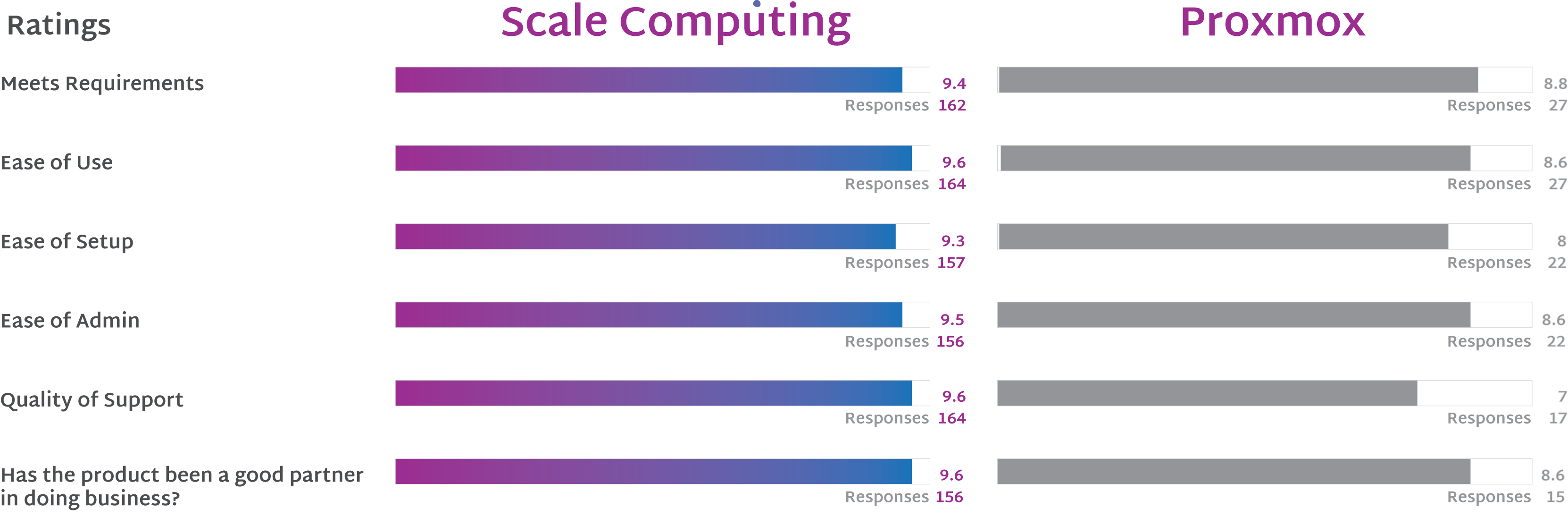
When evaluating Proxmox VE, it's clear that Scale Computing offers a more streamlined, scalable, and cost-effective alternative. With integrated HCI, built-in self-healing automation, superior edge performance, and enterprise-level support, Scale Computing eliminates the complexity and management overhead associated with Proxmox VE. For organizations looking for Proxmox VE alternatives that provide higher efficiency, lower TCO, and superior customer satisfaction, Scale Computing is the best choice.
Use Cases
Proxmox VE looks appealing due to its open-source nature and low initial costs. However, as an organization’s virtualization needs grow, Proxmox VE would limit its scalability, performance, and management, which hinder operational efficiency. Organizations looking for Proxmox VE alternatives have successfully transitioned to Scale Computing’s SC//HyperCore, gaining significant benefits in terms of cost reduction, streamlined management, and improved performance. Here are some use cases where transitioning from Proxmox VE to Scale Computing’s SC//HyperCore would be advantageous.
Retail & Edge Computing Deployments
Retail chains operating multiple storefronts need a virtualization platform that is easy to manage remotely, highly available, and scalable. Many retailers would struggle with Proxmox VE’s complex multi-site management, high latency issues, and manual maintenance requirements.
Why Scale Computing?
- SC//Fleet Manager provides a single-pane-of-glass for managing hundreds to thousands of distributed locations effortlessly.
- Automated updates and self-healing infrastructure eliminate manual maintenance.
- Optimized edge computing performance ensures low-latency, high-speed operations for in-store applications.
Manufacturing & Industrial Operations
Manufacturing companies rely on real-time analytics, IoT devices, and automation to drive efficiency. However, Proxmox VE struggles with high-latency storage configurations, requiring additional management for Ceph storage, which impacts real-time workloads.
Why Scale Computing?
- Integrated storage and compute eliminate the need for separate storage configurations.
- Low-latency architecture ensures real-time analytics for industrial automation.
- Automated failover and disaster recovery improve uptime for mission-critical operations.
Healthcare & Compliance-Driven Industries
Hospitals and healthcare providers must ensure data security, HIPAA compliance, and system reliability. Proxmox VE lacks enterprise-grade support, automated backups, and centralized management, making it less viable for regulated industries.
Why Scale Computing?
- Scale Computing’s Autonomous Infrastructure Management Engine (AIME) has enterprise-grade security and compliance support for healthcare regulations.
- Automated backup and disaster recovery ensure data integrity through Scale Computing Reliable Independent Block Engine (SCRIBE).
- 24/7 customer support eliminates reliance on community forums for troubleshooting.
Why SC//HyperCore is the Best Proxmox VE Alternative
For organizations evaluating Proxmox vs. Scale Computing, the decision comes down to simplicity, scalability, performance, and support. While Proxmox VE can be an attractive entry-level option, it introduces long-term challenges related to complex management, lack of enterprise support, and scalability limitations.
Scale Computing Delivers:
- Fully integrated HCI – No need for third-party storage or complex configurations.
- Seamless scalability – Supports distributed and edge environments effortlessly.
- Optimized performance – Purpose-built for high-efficiency computing with minimal overhead.
- Enterprise-grade support – 24/7 customer service, unlike Proxmox VE’s limited support model.
- Lower total cost of ownership (TCO) – Reduced maintenance and automation-driven efficiency.
For organizations seeking Proxmox VE alternatives that prioritize efficiency, security, and performance, Scale Computing provides a future-ready solution that simplifies IT management while delivering superior results.
Ready to elevate your virtualization strategy? Explore how Scale Computing simplifies virtualization while delivering unmatched performance by taking a self-guided product tour, or request a personalized demo today!
Frequently Asked Questions
What are the main differences between Scale Computing and Proxmox VE for virtualization?
Scale Computing offers an integrated HCI platform with built-in storage, compute, and automation, while Proxmox VE requires manual setup and Ceph storage. Scale Computing provides centralized management and high availability, making it a more efficient Proxmox VE alternative.
Is Scale Computing a better option than Proxmox VE for edge computing?
Yes. Scale Computing is optimized for edge computing with low-latency performance, automated management, and seamless scalability. Proxmox VE struggles with high resource demands and complex storage configurations, making it less efficient for edge deployments.
What types of businesses benefit most from using Scale Computing as a Proxmox alternative?
Businesses in retail, manufacturing, maritime, and healthcare that need scalability, automation, and enterprise support benefit the most. Scale Computing eliminates IT complexity, making it ideal for distributed and edge environments.
How does Scale Computing ensure scalability compared to Proxmox?
Scale Computing supports automated vertical and horizontal scaling with SC//Fleet Manager for centralized multi-cluster management. Proxmox VE requires manual configuration and clustering, making large-scale deployments more challenging.
What support options does Scale Computing offer compared to Proxmox’s community-driven support?
Scale Computing provides 24/7 enterprise support, proactive monitoring, and real-time issue resolution. Proxmox VE relies on community forums, with limited paid support and restricted availability.